
Table of Contents
What Is the Upcoming SEO Marketing in 2027?
The upcoming SEO marketing in 2027 comes down to this: the basics still decide who wins, but more searches will end in an AI-generated answer that cites only a few sources. If you’re hunting for the digital marketer in Pathanamthitta, the harder question is whether the SEO you pay for now will still work then. SEO isn’t dying. But which parts of it matter is shifting, and some popular advice is simply wrong.
What is changing in SEO marketing in 2027?
SEO in 2027 will still rest on a crawlable site, useful content, and a trustworthy business. The difference is that more searches will end in an AI-generated answer that cites a handful of sources. Google’s own guidance says its AI features, including AI Overviews and AI Mode, are rooted in its core ranking and quality systems.
Here’s the mechanism. Google’s guide to optimizing for generative AI search, last updated in July 2026, explains that these features retrieve pages from the regular search index, read them, and write a response with links to supporting pages. The system also uses “query fan-out,” which means it runs related searches you never typed. Ask about fixing a weedy lawn, and it may also look up herbicides and chemical-free weed removal.
What does that mean for you? One strong page can surface for questions you didn’t plan for. Google also says “AEO” and “GEO” are, from its side, still SEO. The label changed. The job didn’t.
Will AI search replace traditional SEO by 2027?
Nobody knows, and anyone quoting you an exact 2027 number is guessing. Plenty of agencies have published forecasts: AI search overtaking organic, citations replacing rankings as the main metric, ads moving into AI answers. Read them as scenarios, not facts. Most come from firms that sell AI-visibility services, so they have a reason to sound urgent.
Here’s what is confirmed. For Google, a page must be indexed and eligible to appear with a snippet before it can show up in AI features. Ordinary search visibility is still the entry ticket.
One caution: other assistants, such as ChatGPT and Perplexity, run their own systems, and Google’s guide doesn’t describe them. Treat Google’s rules as solid for Google. Treat everything else as something to test. For most local businesses, getting Google right first is the sensible order.
What should Pathanamthitta business owners fix first?
Start with the four areas Google itself highlights: a site that’s indexed and crawlable, content nobody else could have written, accurate business listings, and a way to measure results.
| Area | What Google’s guidance says | What you do |
|---|---|---|
| Site basics | Pages must be indexed and snippet-eligible; content must be crawlable | Verify your site in Search Console. Fix blocked pages, duplicate URLs and slow mobile pages |
| Content | Unique, first-hand, “non-commodity” content matters most over time | Show your real work, process and local context, not generic tips |
| Local listings | Business Profile details can appear in AI responses | Keep hours, services and address complete and current |
| Images and video | AI features can pull in images and video | Use original photos of your shop, team or finished work |
| Measurement | Search Console has a Generative AI performance report | Review it monthly |
Two notes on that table.
First, “non-commodity” is worth understanding. A post called “7 Tips for Choosing a Wedding Photographer” could be written by anyone, including an AI tool. A page that shows your actual work, explains how you handle a booking, and tells a local client what to expect can’t be copied so easily. Google says this kind of content will likely influence your AI visibility more than anything else in its guide.
Second, if you only have time for one fix this month, update your Google Business Profile. It costs nothing, and Google names it as a way to be visible in AI responses.
Which SEO tactics can you skip in 2027?
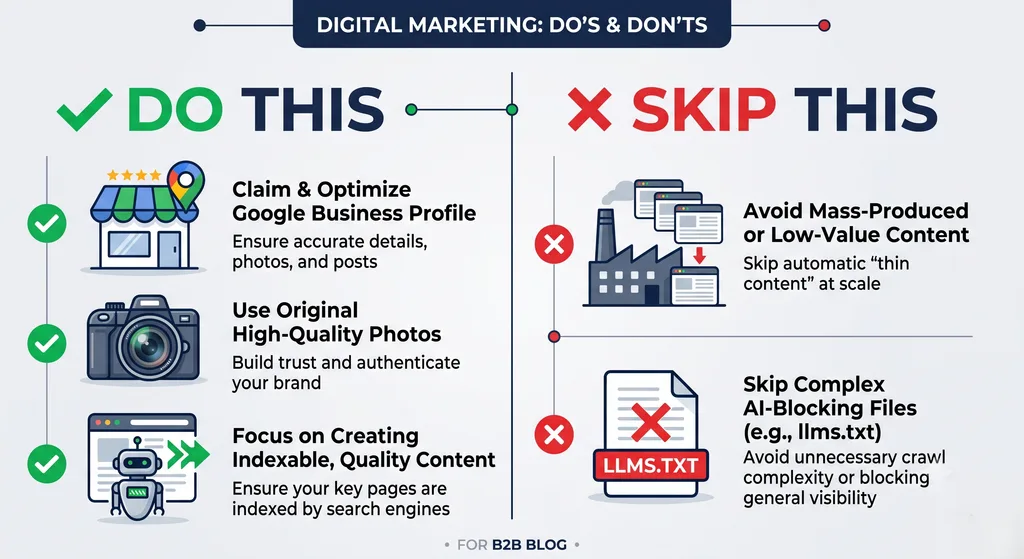
Google’s guide calls several popular “AI SEO” tactics unnecessary for Google Search:
- llms.txt and other special files. Google Search ignores them.
- Chopping pages into tiny chunks for AI to digest.
- Rewriting content in a special style just for AI systems.
- Chasing inauthentic mentions across the web.
- Overfocusing on structured data. No special schema is required, though it still helps with rich results, so keep using it.
An llms.txt file won’t hurt you. It just doesn’t help in Google Search. So if a marketer sells it as the secret to ranking on Google, ask why.
Mass-producing pages is a bigger risk. Creating separate pages for every variation of a query, mainly to manipulate rankings or AI answers, can break Google’s scaled content abuse policy. More pages don’t make a better site.
How will you measure SEO results in 2027?
Keep tracking what you always have: clicks, calls, messages, and form submissions. Add Search Console’s Generative AI performance report, which Google points to for seeing how people find your content through its AI features.
Be wary of tools that promise rankings or claim to use Google’s internal metrics. Google says no third-party tool has access to its internal ranking or AI systems. Ask your marketer for Search Console data, not just a score from a dashboard you can’t verify.
Do local businesses need to prepare for AI agents?
Yes, but it isn’t urgent. Google describes AI agents as systems that perform tasks for people, like booking a reservation or comparing product specs.
Browser agents read your site through screenshots, page structure, and the accessibility tree. Google’s advice is to explore this if it’s relevant to your business and you have spare time.
In practice, it comes down to a site that works properly. Buttons should click, forms should submit, labels should be clear.
Google also notes that semantic HTML helps other types of users, such as screen readers, navigate a page. This is where someone who can read and write code has an edge over someone who only edits settings in a plugin.
What does a realistic 90-day SEO plan look like for 2027?
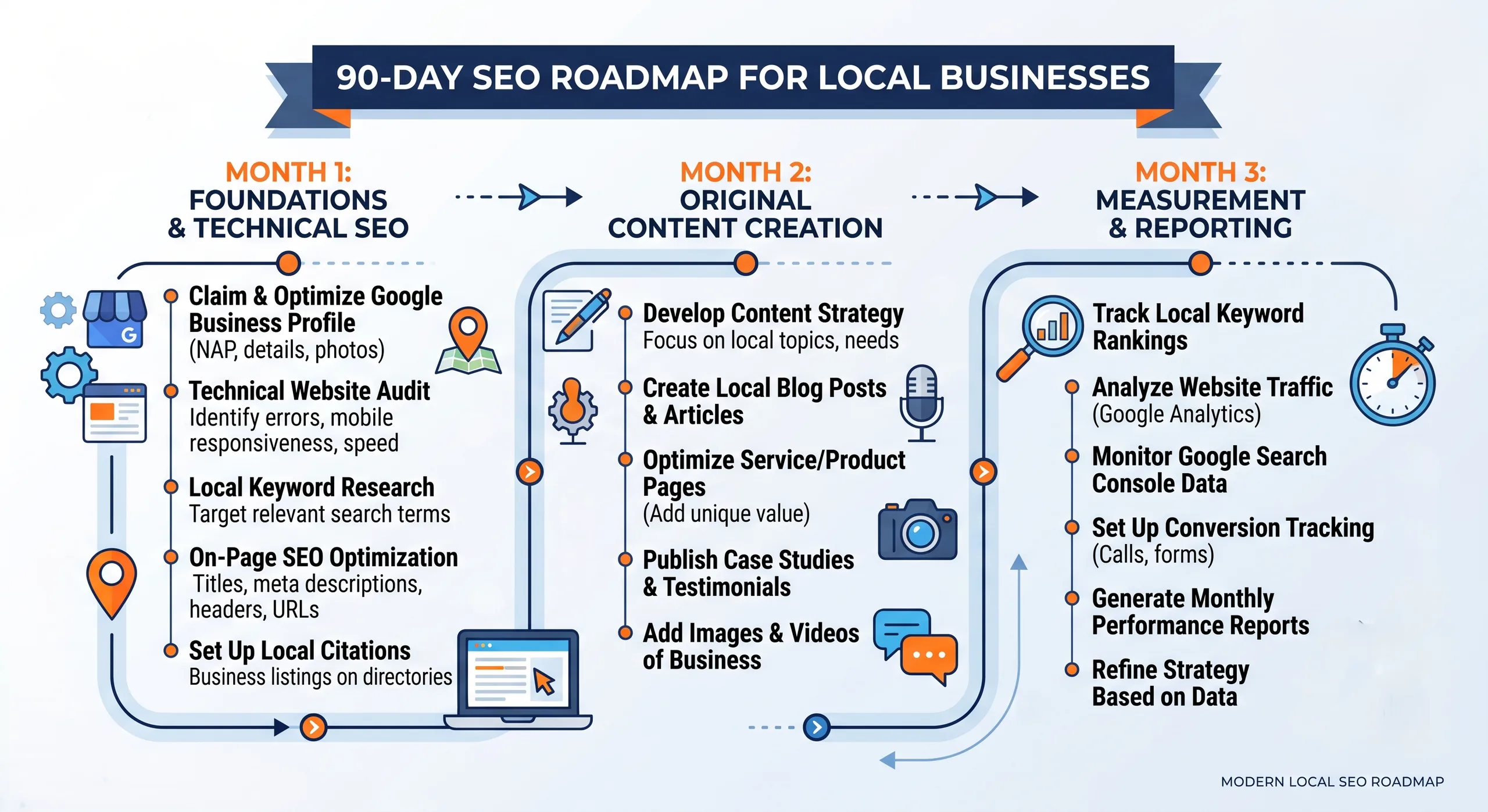
A realistic plan for a small local business is to fix the foundation in month one, upgrade your content in month two, and measure in month three. You don’t need a big budget to start. You need a clear order of work and someone accountable for it.
Month 1: foundations.
- Verify your site in Search Console and check that your key pages are indexed.
- Fix the obvious technical problems: pages that load slowly on a phone, duplicate URLs, broken forms.
- Complete your Google Business Profile with accurate services, hours and address.
Month 2: content people (and AI systems) would actually cite.
- Pick your three most important service pages and rewrite them around first-hand detail: how you work, what a customer can expect, what you’ve actually delivered.
- Replace stock images with original photos or short videos.
- Drop any plan to publish dozens of near-identical pages. It’s the fastest route to a spam-policy problem.
Month 3: measure and adjust.
- Open the Generative AI performance report and see which pages appear in AI features.
- Compare that with enquiries: calls, messages and form submissions.
- Double down on the pages that bring real enquiries, and improve the ones that only bring traffic.
Notice what’s missing from that list: no special files, no tricks, no promises of page one. That’s deliberate. The work that holds up in 2027 is the same work that held up in 2024, done more carefully and measured more honestly.
How do you choose the right SEO partner for 2027?
Nobody publishes a verified ranking of local marketers, so judge by evidence rather than by who says “best” the loudest. A good SEO partner will:
- Show you Search Console data, not only a third-party score.
- Refuse to guarantee a ranking. Google says indexing and serving are never guaranteed.
- Explain what they’d change on your site, and ideally make the change themselves.
- Be upfront about AI-written content and avoid mass-producing pages.
- Introduce you to local clients who’ll vouch for the work.
I’m Abhijith, a freelance digital marketer based in Pathanamthitta, and I write code as well as campaigns. For SEO, that means the technical fixes and the strategy sit with one person. Judge me by the same checklist.
Frequently asked questions
What is the future of SEO in 2027?
SEO in 2027 will still depend on crawlable pages, genuinely useful content and accurate business information, with AI-generated answers appearing more often in search results. Google says its AI features are built on its core ranking systems, so foundational SEO stays relevant.
Is GEO different from SEO?
GEO (generative engine optimization) and AEO (answer engine optimization) are labels for improving visibility in AI answers. Google says that, from its perspective, optimizing for generative AI search is still SEO. Other AI assistants may weigh sources differently.
Do I need an llms.txt file for my website?
No, not for Google Search. Google says it doesn’t use llms.txt files and that creating one neither helps nor harms your Google visibility. You can still create one for other services that read it.
How can a small business in Pathanamthitta show up in AI Overviews?
There’s no guaranteed method. Google says a page needs to be indexed and eligible to show with a snippet, and indexing is never assured. Publish original, useful content, keep your Google Business Profile accurate, and check the Generative AI performance report in Search Console.
How do I know if a digital marketer is good at SEO?
Ask to see Search Console data and a clear plan for your site. Be cautious of anyone who guarantees rankings or sells tricks Google says it doesn’t use, such as llms.txt as a ranking fix.
Will AI-written content hurt my rankings?
Not automatically. Google says AI-assisted content must still meet its Search Essentials and spam policies. Publishing large volumes of pages mainly to manipulate rankings can violate its scaled content abuse policy.
What to do next
Three things this week. Verify your site in Search Console. Bring your Google Business Profile up to date. Replace your most generic page with one that shows your real work. If you’d like a second opinion on where your site stands, get in touch through abhijithh509.com.