How to Build a Digital Marketing Strategy for Small Business Owners
Most small business owners don’t fail at digital marketing because they picked the wrong platform. They fail because they never had a strategy — just a rotating list of tactics tried in isolation, dropped when they didn’t work overnight, and replaced with the next trend. A strategy fixes that by giving every tactic a job to do and a way to measure if it’s doing it.
Table of Contents
What Does a Digital Marketing Strategy Actually Include?
A working strategy answers four questions before a single ad is bought or a single post is published: who you’re trying to reach, where they’re already looking for businesses like yours, what you want them to do when they find you, and how you’ll know if it worked. Skip any one of these and the rest of the plan is guesswork dressed up as marketing.
For a small business, this doesn’t need to be a 40-page document. It needs to be specific enough that you could hand it to someone else and they’d know exactly what to do on Monday morning.
Start With One Customer, Not Every Platform
The instinct when starting out is to be everywhere — Instagram, Facebook, Google Ads, email, maybe a YouTube channel too. That instinct is the fastest way to burn a small budget with nothing to show for it.
Instead, pick the one channel your actual customer already uses to find a business like yours. A local bakery’s customer searches Google Maps and asks in a neighborhood Facebook group — not LinkedIn. A B2B software tool’s buyer reads comparison articles and asks peers — not Instagram Reels. Match the channel to the buying behavior, not to what’s trending.
Where Should the Budget Actually Go First?
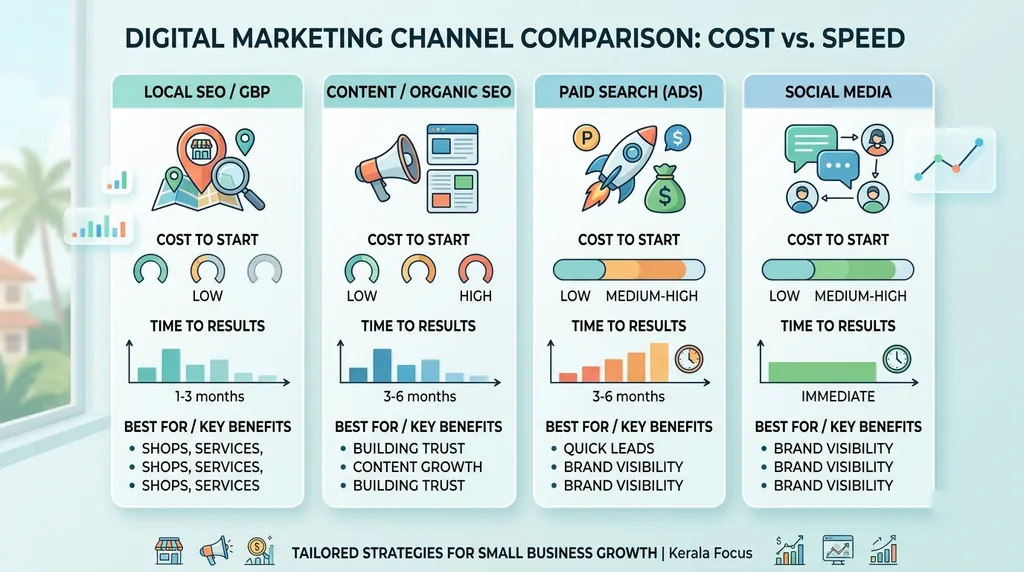
This is the table version of the same idea — a quick comparison of where a small budget tends to work best and how fast it pays off:
| Channel | Cost to Start | Time to Results | Best For |
| Local SEO / Google Business Profile | Low | 1–3 months | Shops, clinics, services with a physical address |
| Content / Organic SEO | Low–Medium | 3–6 months | Building long-term trust and search traffic |
| Paid Search (Google Ads) | Medium–High | Immediate | Quick leads when there’s already demand |
| Social Media | Low | Varies widely | Brand visibility, community, repeat customers |
A common mistake is chasing paid ads for a business that hasn’t fixed its Google Business Profile yet. Local SEO is nearly free and often converts better than ads, simply because someone searching “near me” is already closer to buying.
Content or Ads First? Pick Based on How Much Demand Already Exists
If people are already searching for what you sell, paid search captures that demand quickly — you’re just paying to be the answer they find first. If demand doesn’t exist yet and you need to educate people or build trust before they’ll buy, content and SEO do that work, just more slowly.
Most small businesses need both eventually. The strategy question isn’t which one is better — it’s which one closes the gap you actually have right now.
The Three Numbers That Actually Matter
Vanity metrics like follower counts and impressions feel good and mean almost nothing for a small business’s bottom line. Track these three instead:
- Cost per lead — what you spend to get one qualified inquiry, by channel
- Conversion rate — the percentage of leads who actually become paying customers
- Customer acquisition cost versus customer lifetime value — whether marketing spend is actually profitable, not just active
If you can’t answer these three for your current marketing, that’s the first gap to close — before adding a new channel or increasing spend on an existing one.
A Simple 90-Day Rollout
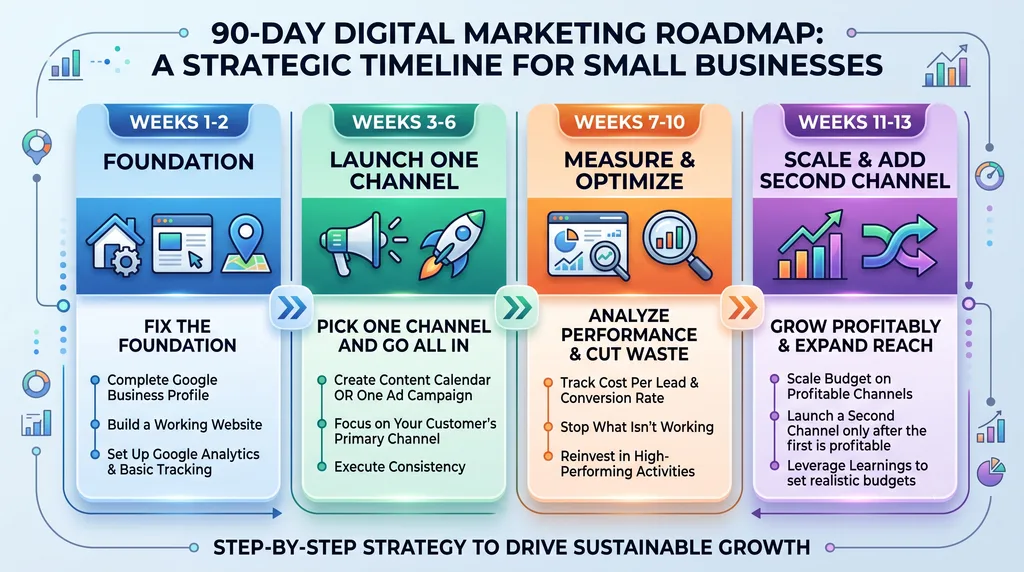
A strategy is only useful if it turns into a sequence of weeks, not a wish list. A workable first 90 days looks like this:
- Weeks 1–2: Fix the foundation — Google Business Profile, a working website, basic tracking (Google Analytics, call tracking, or a simple lead form)
- Weeks 3–6: Launch one channel fully — either a content calendar or a single ad campaign, not both at once
- Weeks 7–10: Measure cost per lead and conversion rate, cut what isn’t working, double down on what is
- Weeks 11–13: Add a second channel only once the first is profitable, using what you learned to set a realistic budget for it
This order matters more than the specific tactics inside it. Businesses that skip the foundation step usually end up paying for traffic that lands on a site with no way to track what happened next.
Getting This Right Without Guessing
A lot of this comes down to having someone who understands both the marketing side and the technical side — someone who can set up tracking correctly, not just recommend that it exists. That’s the gap that trips up most small business owners handling this alone: the strategy is sound on paper, but the technical execution — pixel tracking, site speed, schema markup — quietly undermines it.
If you’re based in Kerala and want a second opinion on where your current marketing is leaking budget, that’s exactly the kind of audit a freelance digital marketer with a development background can walk through with you line by line.
Frequently Asked Questions
What’s the difference between a digital marketing strategy and just running ads?
Running ads is one tactic. A digital marketing strategy is the plan that decides which tactics to use, in what order, and how to measure whether they’re working — so ads, SEO, and content all point at the same goal instead of pulling in different directions.
How much should a small business spend on digital marketing?
Most small businesses do well starting with 5–10% of revenue and adjusting based on what’s actually converting. It’s better to run one channel properly on a small budget than to spread a small budget thin across five.
Do I need a website before I start marketing?
Yes, at minimum a simple one. Social profiles get accounts suspended and don’t build search equity over time. A basic website you own gives every other channel — SEO, ads, email — somewhere permanent to send people.
How long does it take to see results from digital marketing?
Paid ads can bring leads within days. SEO and content typically take three to six months to gain traction because search engines need time to trust a growing site. Plan a strategy that includes both a fast channel and a compounding one.
Can a small business owner run digital marketing without an agency?
Yes, for the basics — a Google Business Profile, a simple content calendar, and one ad campaign are manageable in-house. Bringing in outside help usually pays off once you need technical SEO, ad account structuring, or design at scale.
The Next Step
Pick one channel from the table above, commit to it for 90 days, and track the three numbers that matter. That’s a strategy — everything else is just activity.