
What is Local SEO? Complete Beginner Guide for Small Businesses
If you run a shop, a clinic, a salon, or pretty much any business that serves people in a specific area, you’ve probably heard someone say “you need local SEO.” Maybe you nodded along and quietly wondered what that actually means.
You’re not alone. Most small business owners I talk to know they want to “show up on Google” but have never had anyone explain the mechanics in plain English. This local SEO beginner guide is meant to fix that. No jargon dump, no fluff — just a clear walk-through of how local search actually works and what you can do about it this week.
By the end, you’ll understand why your business shows up (or doesn’t) when someone nearby searches for what you sell, and you’ll have a short list of real actions to take. If you’d rather hand the whole thing off, working with someone like the best digital marketer in Pathanamthitta can save you a lot of trial and error. But even if you hire help, you should know what’s going on under the hood.
Table of Contents
How This Local SEO Beginner Guide Views Traditional SEO
As this local SEO beginner guide explains, traditional SEO and local SEO chase the same prize — visibility — but they measure success differently.
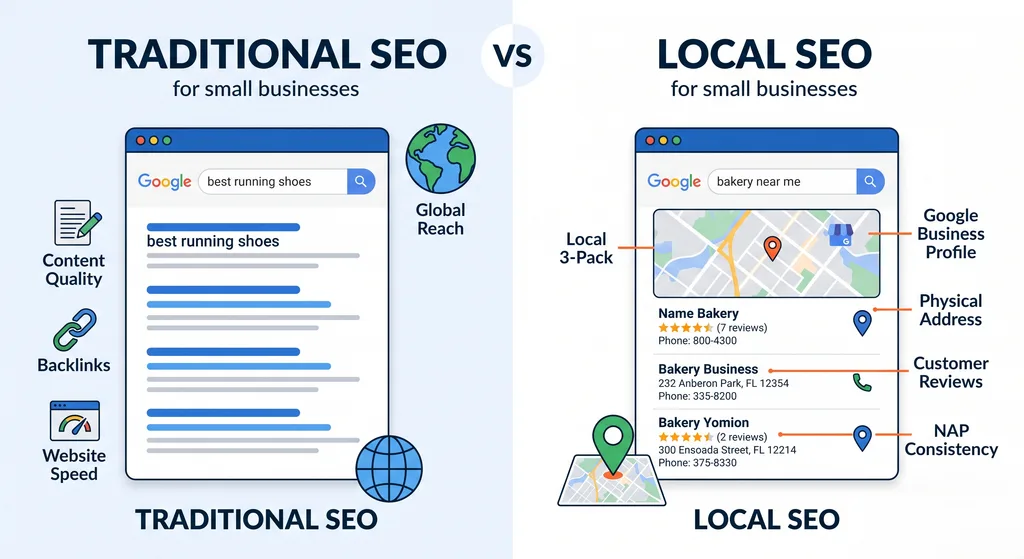
Traditional SEO is about ranking a website for a keyword, period. Think “best running shoes” or “how to fix a leaky faucet.” Google cares about content quality, backlinks, site speed, and relevance to the query. Location rarely matters.
This local SEO beginner guide shows that local SEO adds a layer on top of all that: geography. When someone searches “plumber near me” or “bakery in Pathanamthitta,” Google isn’t just trying to find the most authoritative plumbing website on earth. It’s trying to find the plumber most likely to actually show up at your door today.
A few things that make local different:
- Google Business Profile matters more than your website. For many local searches, your free business listing carries as much weight as your site.
- Reviews become a ranking signal. A blog post doesn’t need five-star reviews. A dentist’s office does.
- Your physical address and service area are part of the algorithm. You can’t fake being nearby.
- Consistency across the web counts. Your business name, address, and phone number (often called NAP) need to match everywhere they appear.
If you only ever optimize your website and ignore your Google Business Profile, you’re fighting local SEO with one hand tied behind your back.
The Local 3-Pack vs Blue Links
Here’s something that confuses almost everyone new to this: not all Google results look the same, and that matters a lot for small businesses.
When you search something with local intent, Google usually shows a map with three business listings above the regular organic results. That’s the “local 3-pack” (sometimes called the map pack). Below it come the standard blue links — your typical website listings.
Here’s why this distinction matters so much:
| Feature | Local 3-Pack | Blue Links (Organic) |
|---|---|---|
| What’s shown | Map + 3 business listings | Website titles and descriptions |
| Driven mainly by | Google Business Profile | Website content and backlinks |
| Reviews visible | Yes, star ratings shown | No |
| Click behavior | High for “near me” searches | High for research/informational searches |
| Best for | Walk-in or call-now businesses | Content-driven or national businesses |
A huge chunk of local search traffic goes to those top three map results before anyone scrolls further. If your business isn’t in that pack for your key searches, you’re likely losing customers to competitors who are — even if your website itself is better built than theirs.
Takeaway: If you’re brick-and-mortar, winning a spot in the 3-pack should be your priority over chasing a page-one blue link ranking. They’re both useful, but the 3-pack is where the buying intent lives.
Proximity, Prominence & Relevance
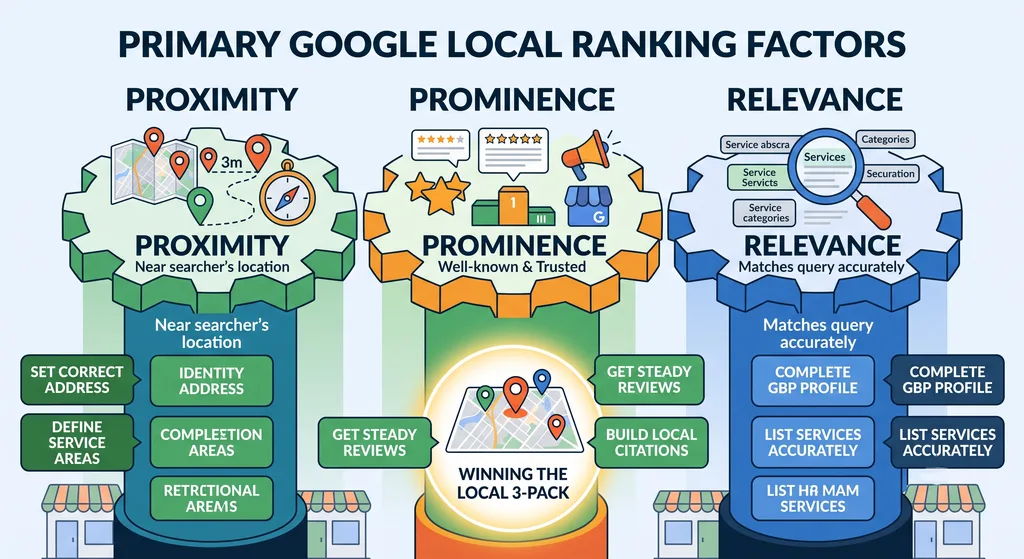
Google has publicly explained that local ranking comes down to three main factors, and understanding them helps you stop guessing. According to Google Search Central, these are proximity, prominence, and relevance.
Proximity
How close is the business to the person searching (or to the location they typed in)? You can’t move your shop just to rank better, but you can make sure your address is listed correctly everywhere and that you’ve set your service areas accurately if you travel to customers.
Prominence
This is about how well-known and well-reviewed your business is, both online and off. Review count and quality, press mentions, and even how often people search for your business by name all feed into this. A shop with 150 genuine five-star reviews is going to outrank a near-identical one with twelve.
Relevance
Does your listing actually match what the person searched for? This comes down to your business categories, the keywords in your business description, and how well your services are described on your website and profile. A “hair salon” category won’t help you rank for “men’s barber” searches if that’s not reflected anywhere in your listing.
The honest truth: you have real control over relevance and prominence, partial control over proximity, and zero control over where the searcher is standing. Focus your energy where it pays off.
Action Items for Brick-and-Mortar
Enough theory. Here’s what to actually do, roughly in order of impact:
- Claim and fully complete your Google Business Profile. Fill in every field — hours, categories, services, photos, attributes. Incomplete profiles rarely win the 3-pack.
- Get your NAP consistent everywhere. Check your website, Facebook, directory listings, and anywhere else your business is mentioned. Mismatched addresses or phone numbers quietly hurt you.
- Ask happy customers for reviews — consistently, not just occasionally. A steady trickle of fresh reviews looks more natural and helpful than one burst.
- Add location-specific content to your website. A page that mentions your city, neighborhood, and the specific services you offer there does real work.
- Respond to every review, good or bad. It signals activity and care, both to customers and to Google.
- Build a few relevant local citations. Chamber of commerce listings, local directories, and industry-specific listings all help prominence.
- Check your categories and service descriptions for relevance. Don’t just pick the closest generic category — be specific.
None of these fixes happen overnight, and that’s worth saying plainly: local SEO is a slow build, not a switch you flip. But each item on that list compounds over the following months.
Quick Summary
- Local SEO adds geography (proximity, reviews, listings) on top of traditional SEO’s content and link signals.
- The local 3-pack, driven mostly by your Google Business Profile, is where most “near me” buying intent lives.
- Google ranks local results using proximity, prominence, and relevance — you control two of the three.
- Start with your Google Business Profile, consistent NAP, and a genuine review habit.
FAQ
Is local SEO different from a Google Business Profile? They’re related but not the same thing. Your Google Business Profile is one tool (a very important one) within the broader practice of local SEO, which also includes your website, citations, and reviews.
How long does local SEO take to show results? Most small businesses start seeing movement within a few months of consistent work, though competitive areas can take longer. There’s no fixed timeline — it depends on your market and current starting point.
Do I need a website if I already rank well on Google Maps? Yes, ideally. A website supports relevance signals and gives customers a place to learn more, book, or buy, which also builds the prominence Google rewards.
Can a service-area business (no storefront) do local SEO? Absolutely. You set a service area instead of a public address on your Google Business Profile, and the same ranking principles — proximity, prominence, relevance — still apply.
What’s the single biggest mistake beginners make? Setting up a Google Business Profile once and then ignoring it. Local SEO rewards ongoing activity: new photos, fresh reviews, and updated posts.
Final Thoughts
Local SEO isn’t some mysterious trick reserved for big companies with marketing departments. It’s a practical, learnable system built around three ideas: being close enough, being trusted enough, and being relevant enough. This local SEO beginner guide covered how it differs from traditional SEO, why the 3-pack deserves your attention, and what actually moves the needle for a brick-and-mortar business.
Start with the Google Business Profile. Keep your details consistent. Ask for reviews. Do those three things well for a few months and you’ll likely notice the difference yourself — before any report tells you so.